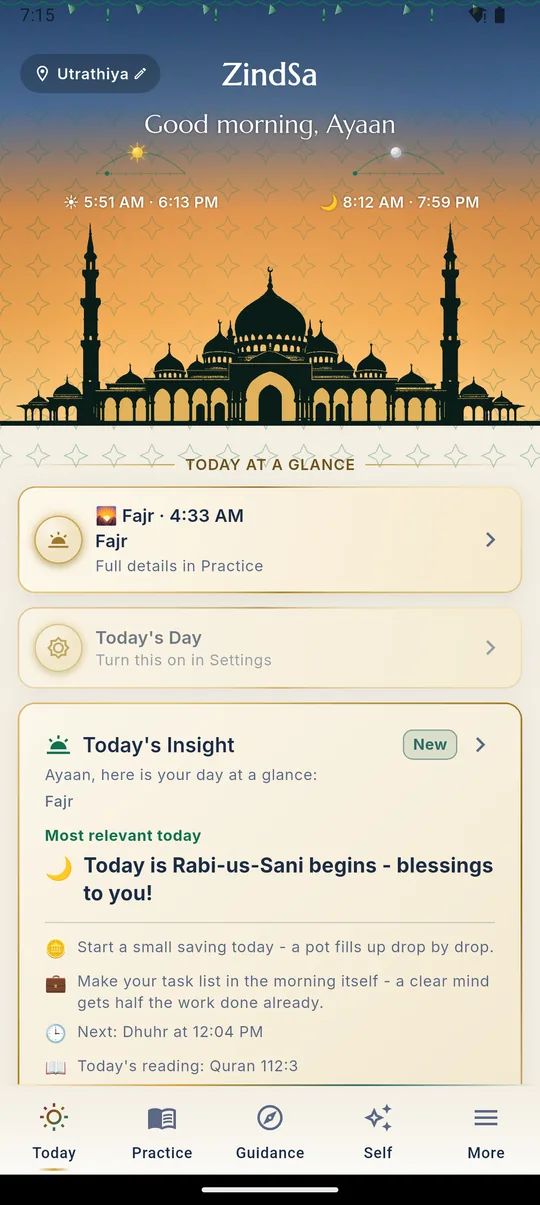
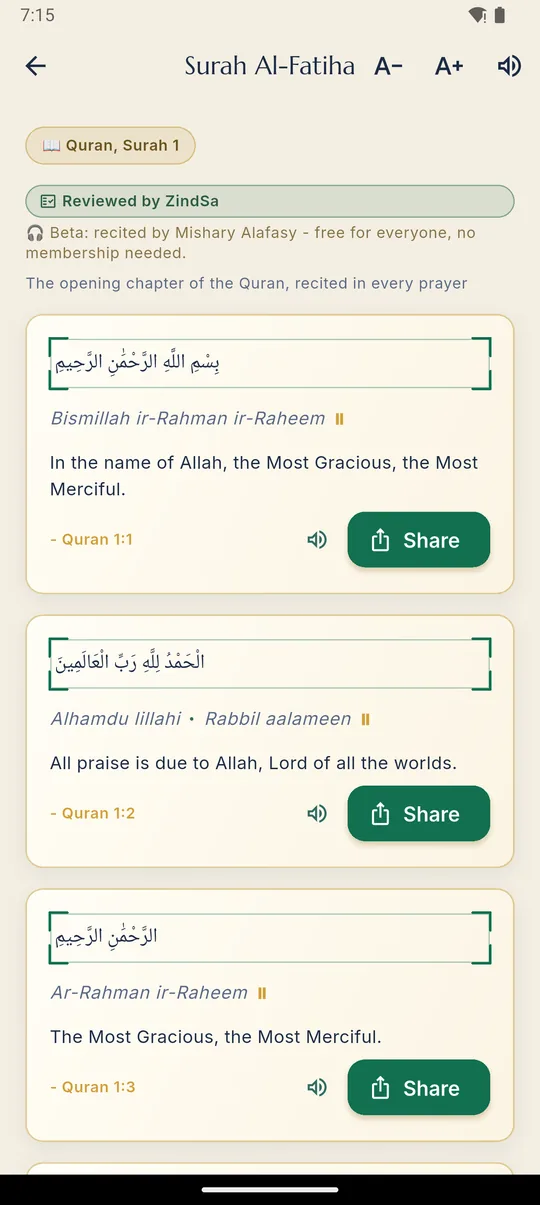
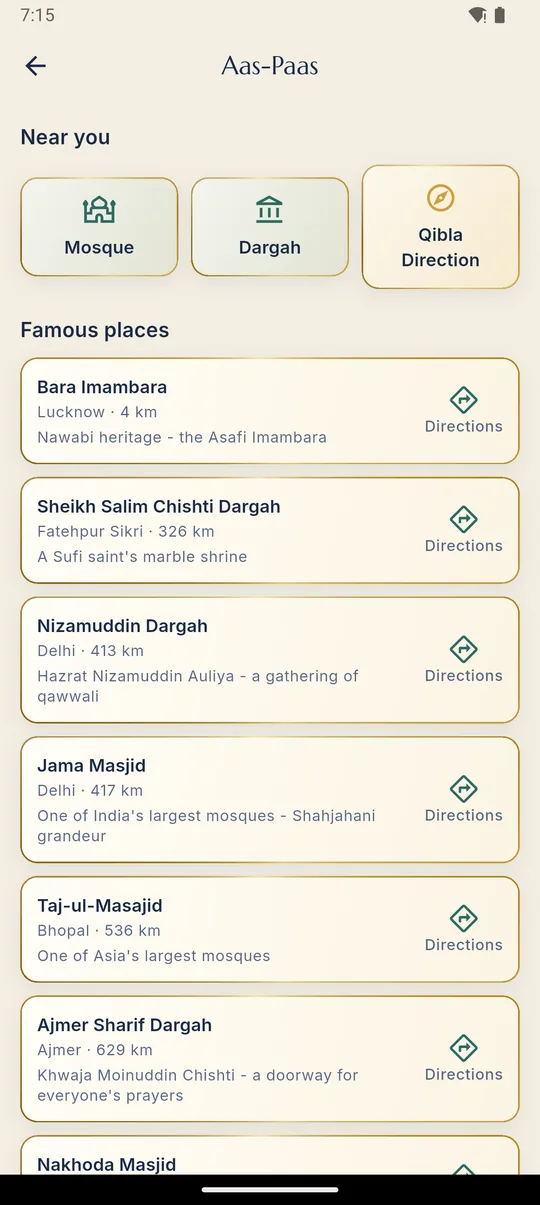
Prayer times and qibla worked out on your own device, with the one convention that could be sourced, and the two offsets that are common practice rather than a citation.
Muslim profiles get prayer times, the qibla, and the Quran reader with its recitation, which is free. The dharmik calendar carries 12 computed Muslim events.
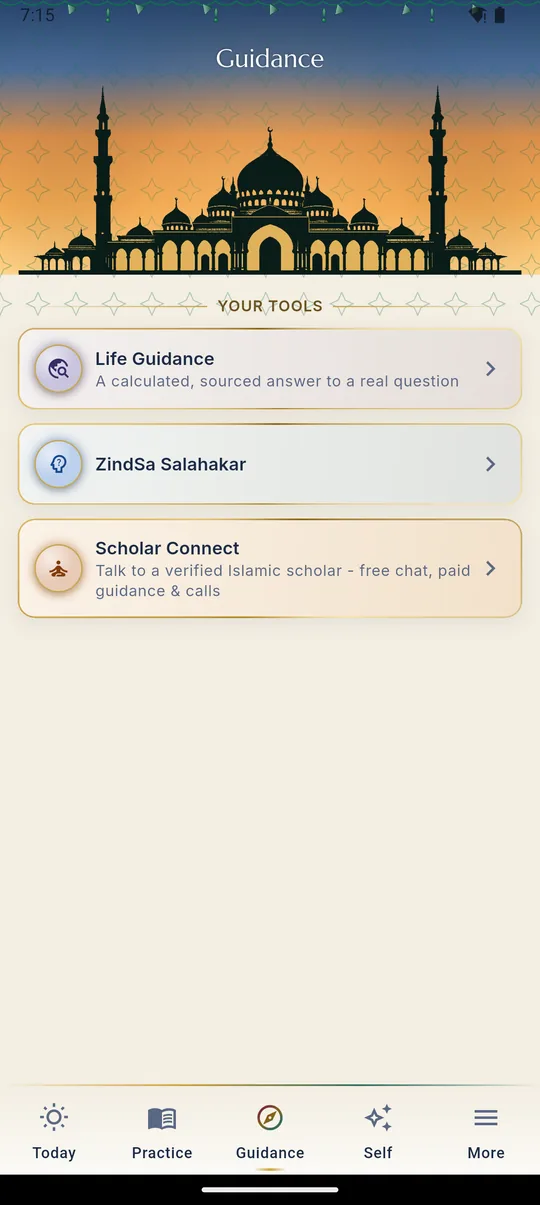
Everything shared across the six dharmas is here too: the scripture library in its own script, Verse of the Day, Life Guidance, the AI Salahkar, sankalp, daan, reports, and all ten interface languages.
Prayer times use the University of Islamic Sciences, Karachi convention, Fajr and Isha at 18 degrees, calculated on your own device. You can choose the Asr school in Settings: Hanafi, shadow factor 2, which is the default, or standard, factor 1.
The qibla arrow is a great-circle bearing to the Kaaba, corrected from magnetic to true north using the device's geomagnetic field model.
Only the Karachi convention ships. No other institution's angles exist in this project, and writing them down from recollection is not something the app will do, so the 18 degree twilight angles are not adjustable.
Two offsets are common practice rather than a published figure, and the app says exactly that on the prayer card: Maghrib is set 3 minutes after sunset and Dhuhr 2 minutes after solar noon, as a safety margin. Times may differ by a few minutes from your local mosque.
The Quran audio beta covers 3 short passages with a human reciter, and is a Pro feature. It is 3 passages, not 3 surahs: one of them is a single ayah inside a longer surah.
ZindSa checks its own content against published editions, and the source, locator and date for each check are recorded in the app itself. No external scholar and no religious body has endorsed it, and this page does not claim otherwise. What is checked here is mechanism, not authority.
Muhurat and vastu are Hindu-jyotish systems. They are shown to whoever opens them, and the app says on its own screens that it carries no equivalent from any other tradition. It does not relabel them as yours. The plain-language meanings printed beside the verses, in every dharma, have authorship the licence register has not yet established, and that row is open rather than quietly closed.
Related: which method ZindSa uses for prayer times, and what ZindSa does not do for your dharma. All questions.