A daily Vak drawn from the app's own Gurbani corpus with no prediction attached, gurpurabs computed from the Bikrami tithi, and no Nanakshahi engine.
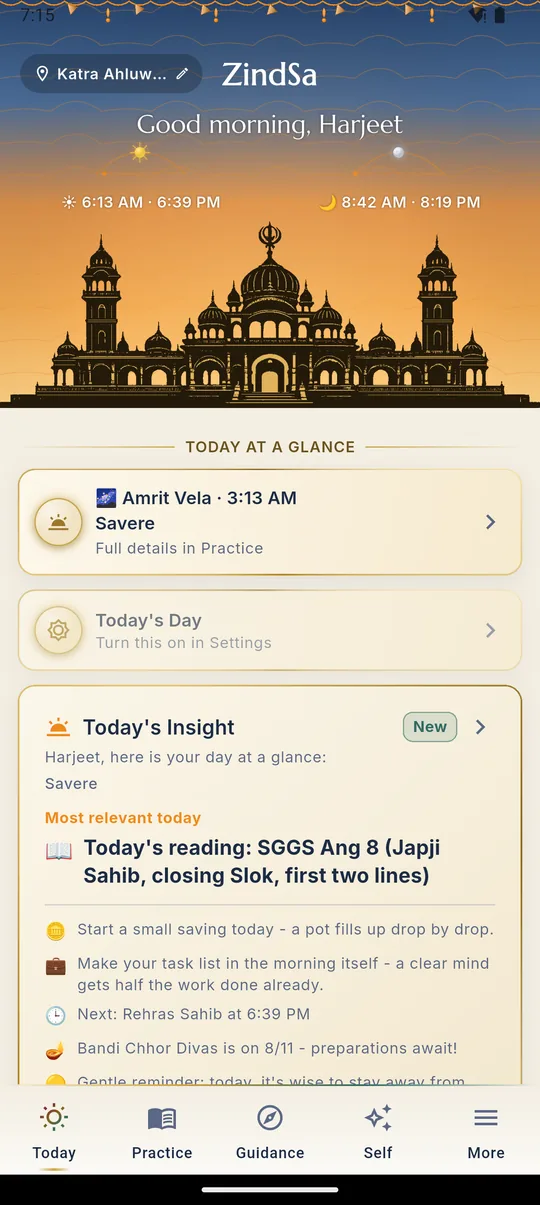
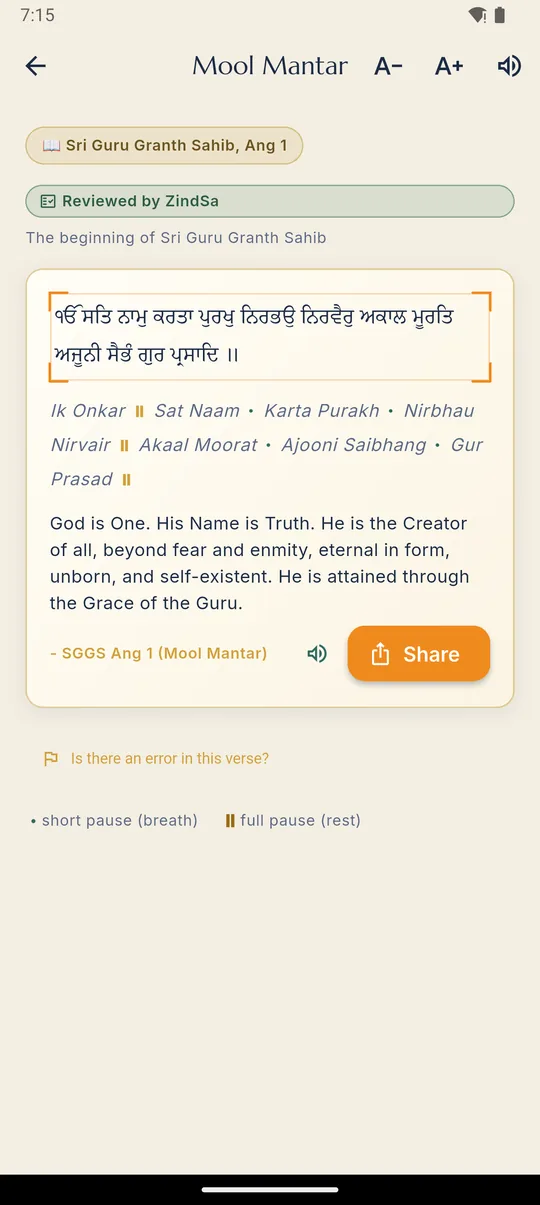
Sikh profiles get a daily Vak, drawn deterministically by calendar day from the app's own Guru Granth Sahib corpus, with its already-vetted translation and no prediction attached. Everyone opening the app on the same date sees the same passage, and it cannot be rerolled. A daily reminder can be switched on.
The corpus is ten passages in Gurmukhi from four Angs: the Mool Mantar and the Slok and first two pauris of Japji Sahib from Ang 1; the closing Slok of Japji Sahib and the opening line of So Dar from Ang 8; the Sukhmani Sahib Mangalacharan from Ang 262; and the first pauri of Anand Sahib from Ang 917.
Five gurpurabs ship. The dharmik calendar carries 5 computed Sikh events.
This is the part to be precise about. Gurpurab dates are computed from the Bikrami lunar tithi. There is no Nanakshahi engine in ZindSa and no sangrand computation anywhere in the code.
Two of the five additionally carry a fixed Nanakshahi date under the SGPC 2003 calendar, shown beside the Bikrami one as a labelled alternative, because the two reckonings genuinely disagree and picking one silently would be the wrong call. Those two Nanakshahi dates are constants in the source rather than derived, and they are labelled as such.
The daily Vak is a personal draw from the app's own corpus. It is not a live feed from any gurdwara. ZindSa carries no such feed, and it never labels a personal draw as one.
There is no Nanakshahi engine. The Punjabi nakshatra names are still English placeholders. Further Japji pauris, and the body text of Rehras and Chaupai Sahib, were deliberately not added, and that omission is recorded as an omission rather than as a plan.
ZindSa checks its own content against published editions, and the source, locator and date for each check are recorded in the app itself. No external scholar and no religious body has endorsed it, and this page does not claim otherwise. What is checked here is mechanism, not authority.
Muhurat and vastu are Hindu-jyotish systems. They are shown to whoever opens them, and the app says on its own screens that it carries no equivalent from any other tradition. It does not relabel them as yours. The plain-language meanings printed beside the verses, in every dharma, have authorship the licence register has not yet established, and that row is open rather than quietly closed.
Related: what ZindSa shows Sikh users, and what ZindSa does not do for your dharma. All questions.