Who builds ZindSa
ZindSa is built by EWUS Technologies. The app credits “EWUS Technologies · Made in India” on its own About screen, and the Privacy Policy and the Terms of Service, both effective 15 September 2026, are published under that name. The Terms state that the law of India applies and name Jaipur, Rajasthan, as the jurisdiction. Written contact is support@zindsa.com, the same address the app shows on its support tile. That is deliberately the whole of it. This page gives no team size, no founding story and no professional credentials, because a page about credibility should carry only what a reader can go and check.
What the app is, and when it arrives
ZindSa is a devotional companion for six dharmas, Hindu, Muslim, Sikh, Christian, Jain and Buddhist, in ten interface languages, each written in its own script. It is due on Google Play on 17 September 2026. There are no user numbers, ratings or testimonials anywhere on this site, because the app has not launched and none of them exist. There is no advertising in it either: no ad SDK is present in the build.
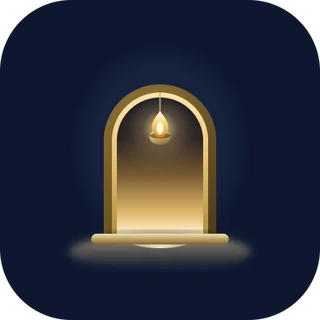
The mark
ZindSa’s icon is a doorway with a lamp left lit inside it. There is no Om on it, no crescent, no khanda, no cross, no swastik and no dharmachakra. That absence is deliberate, and it follows the same rule as everything else in this app: no tradition here is the default, and none is an addition to another. What the six do share is a threshold. A temple, a mosque, a gurdwara, a church, a derasar and a vihara agree on almost nothing in their imagery, and every one of them has a door you cross to enter. The lamp is the part that matters. Nobody is standing in the doorway. It is lit anyway, because it was lit for whoever comes. And the light does not stay politely inside: it falls across the step and outward, reaching you before you have taken a step. What lies beyond the door, ZindSa does not draw. That part is yours.
Which texts the app quotes, and in which language
Every shipped text and asset has a row in the app’s licence register, and a text with no provenance does not ship. For five of the six dharmas the register’s answer to “which edition?” is that the question does not arise: what the app quotes is the source-language original. Sanskrit and Prakrit for the Hindu and Jain texts, Rigveda 3.62.10 and 7.59.12, Bhagavad Gita 2.47, the opening sutras of the Tattvartha Sutra, the first verse of the Bhaktamara Stotra, the Namokar Mantra. Arabic for the Quran passages, Surah 1, Surah 112 and 2:255. Gurmukhi from Guru Granth Sahib, the Mool Mantar and Japji Sahib from Ang 1, the closing Slok and So Dar from Ang 8, the Mangalacharan of Sukhmani Sahib from Ang 262, the first Pauri of Anand Sahib. Pali for the Tisarana, the Panca Sila and Dhammapada 1 and 183. These are ancient source texts, recorded in the register as public domain by antiquity, row by row. One row is deliberately carved out of that blanket. Dhammapada 5, shipped inside the same Buddhist text, has a Pali original that is public domain like the rest, but its English is ZindSa’s own rendering, written on 6 August 2026 and labelled tr. ZindSa, because the translation shipped before it was licensed for fee-free distribution only and this app sells a Pro tier. The register holds it as its own row, part public domain and part first-party, and says plainly that the row settles the licence and not the accuracy: fidelity to the Pali is still on the review list.
The one exception: the Christian texts are read in translation
The Christian rows are the exception, and the register says so plainly: the app does not quote these passages in their source languages, Hebrew and Greek, but in translation, and the register names each translation. The seven passages in the Christian reading corpus are shown in English from the King James Version of 1611, which is public domain. In Hindi, Marathi, Punjabi, Bengali, Gujarati, Tamil and Telugu the same passages are shown from the Indian Revised Version, copyright Bridge Connectivity Solutions and licensed under Creative Commons Attribution-ShareAlike 4.0 (CC BY-SA 4.0); the app reproduces them word for word. In Arabic they are shown from the Van Dyck translation of 1865, which is public domain. Urdu does not have its own wording yet, so an Urdu reader sees the King James English. The register records each wording as checked, before it shipped, against two independent published copies of that translation. Until 14 September 2026 these passages carried a Hindi wording whose edition was never established, and it was removed rather than kept on a licence the register could not confirm. The Christian Life Guidance module holds no verse wording of its own at all: five of its answers give the reference and nothing else, one looks its verse up at runtime from the app’s own corpus rather than keeping a copy, and one domain is left uncovered because no passage in that corpus fits it. Five verbatim passages of a named modern English translation were removed from that module rather than re-worded, because no verified public-domain rendering of them existed in the app. The module says so on screen, in its own words: “English Bible translations differ materially in wording, and this app does not ship a translation of its own, so rather than reproduce one, it points you to the passage. Open it in whichever Bible you read.” The plain-language meanings shown beneath verses in every dharma are recorded the same way: their authorship is not yet established, and the register carries one open row standing for all of them.
How a calculation is checked
Panchang, kundli, prayer times and qibla are computed on your own phone, from astronomical series rather than looked up from a stored almanac. Those engines are held by named checks kept under audit/checks/ in the project’s own repository, and the rule for a check is that its expected value must come from outside the code it tests, an ephemeris library, a published convention, a licence document, a price config, never the implementation restating itself. Planetary positions are tested against Swiss Ephemeris; the largest residual measured in the project’s own test run was 0.6 arcseconds, for the slowest-moving body. And a check does not count merely because it passes. The written mutation discipline requires that the code be deliberately broken, that the break be proved to have landed in the file, and that the check be watched going red, before that check is accepted as evidence of anything.
Devotional practice is never behind Pro
Ten named practices, scripture reading, jaap mala, Ram Shalaka, prayer times, qibla, the dharmik calendar, sankalp, daan, verse of the day and Life Guidance, sit on a protected register of surfaces, and a build-time check fails if a Pro gate appears on any of them at all. The rule is unconditional: the published exemption list is empty. It has not always been empty. Until 6 August 2026 one exemption stood, the Quran-audio beta, where the recorded recitation sat behind Pro. That gate was removed, because recited tilawat is the practice itself and not a convenience laid on top of it, and the exemption line was deleted with it rather than left behind to cover a gate that no longer exists. The recitation is free for everyone. Kundli, Numerology, Vastu, Muhurat and Predictions are free as well, with nothing locked.
What the app leaves out, and how ZindSa checks its sources
The most useful list on this page is of things the app declines to show. The muhurat engine leaves out Vijaya, Dur Muhurat, Amrit Kaal, Varjyam, Sarvartha Siddhi, Ravi, Dwipushkar and Tripushkar, because their tables are not yet verified and, in the engine’s own words, putting a flag on a wrong number does not make it right. Prayer times name their method, University of Islamic Sciences, Karachi, Fajr and Isha at 18°, and the prayer card itself discloses that the 3-minute Maghrib and 2-minute Dhuhr margins are common practice rather than a figure from a published source. Where Tamil and Malayalam panchangs follow a different day-rule, the app names the divergence instead of quietly picking one. And the limit that matters most on a page like this: what is checked here is mechanism, not authority. ZindSa checks its own content against published editions, the source, locator and date for each check are on record in the app itself. No external scholar and no religious body has endorsed it, and this page does not claim otherwise.
More detail? The FAQ answers the fourteen questions people ask most often. The full Privacy Policy and Terms are public, and you can write to support@zindsa.com.